Pure Functions
Pure functions don’t refer to any global state. Those functions do not produce any side effects (state changes).
Why?
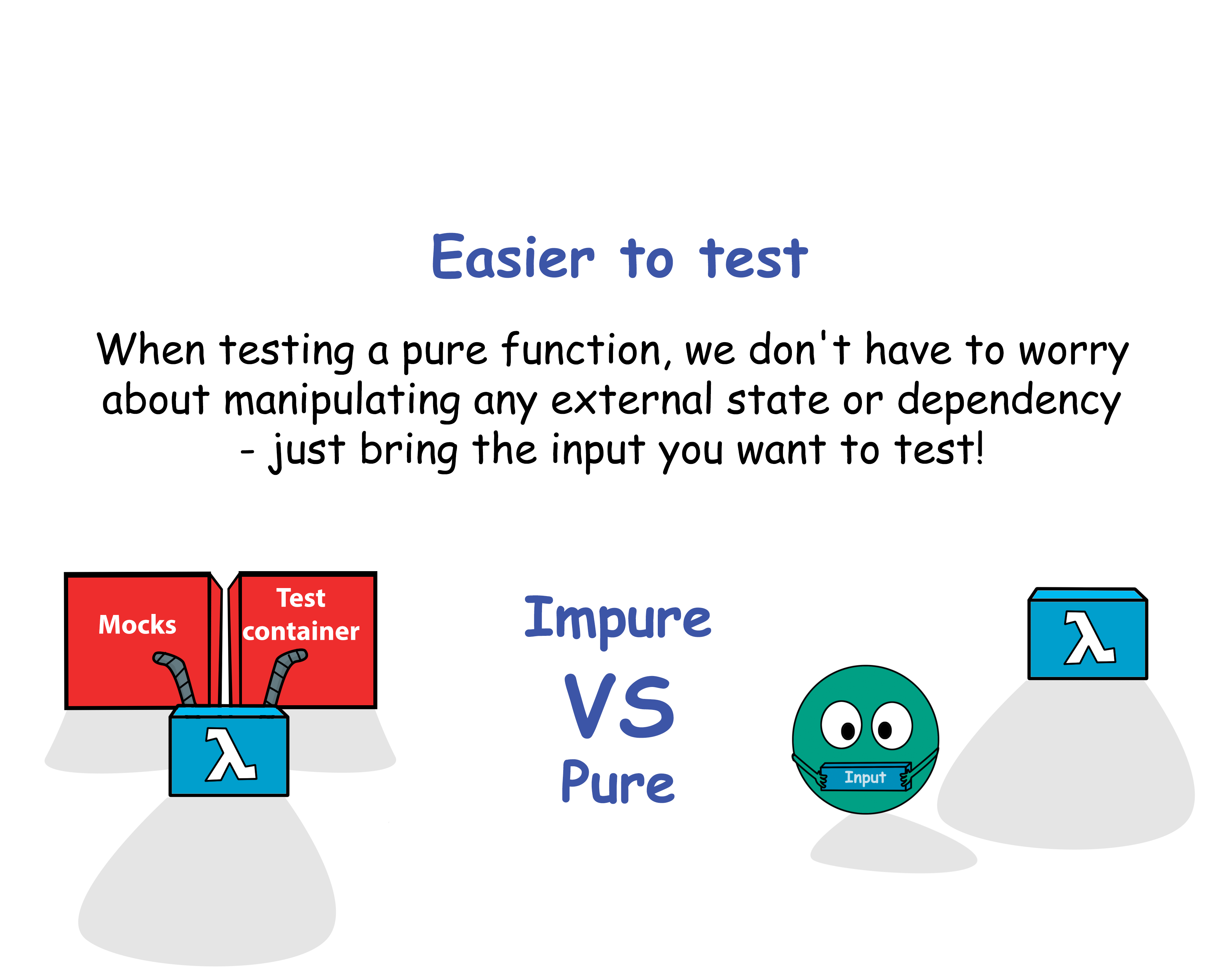
They are easier to test because of these properties :
- You can see all the input in the argument list
- The execution is deterministic : the same input will always get the same output
- You can see all the output in the return value : easier to understand / maintain
Code that is harder to test will lack some or all of these properties.
There are other benefits than testing from writing only pure functions :
- Parallelization : without any shared state to worry about, we can easily parallelize calculations across multiple threads
- Memoization : since the same input always result in the same output we can cache the results of our function
- Lazy evaluation : we can delay function evaluation only when it's actually needed
Problems
- How could we design more robust code?
- How could we write more predictive code?
How to
Take some habits :
- Never mutate any input value from a function
- Never mutate the object in which the function is declared
In both cases, prefer to return a new instance of the object you want to mutate
Apply this simple checklist :
✅ Same inputs always return same outputs
✅ No side-effects
Pure vs Impure functions
Impure functions
Impure functions often break the Command Query Separation (CQS) principle that says we should divide our object methods into 2 separated categories :
- Queries : Return a result and do not change the observable state of the system (are free of side effects)
- Commands : Change the state of a system but do not return a value.

public class MathUtility {
    private static int countCall = 1;
    public static int sum(int num1, int num2) {
        countCall++;
        multiply(num1,num2);
        return num1 + bnum2;
    }
}
public class Line {
    private int value = 0;

    public int add(int nextValue) {
        this.value += nextValue;
        return this.value;
    }
}
Pure functions
Pure functions are in fact queries on our system.
const double = (x) => x * 2;
import random

def f(x):
    if random.randint(1, 2) == 1:
        return x + 1
    return x + 2
Constraint
Write only pure functions during the next 20 minutes. If you are working on a method / function right now : refactor it to make it pure.
Resources
- The Definition of "Pure Function"
- Why Pure Functions? - 4 benefits to embrace
- CommandQuerySeparation
Feature images: Marius Herring